

The Ripple Effect: Ten Years of UNDSCVRD and the Cultural Renaissance It Helped Spark
Ten years ago, we threw a rock into a pond. We called it UNDISCOVERED.
At the time, we weren't trying to build a movement. We were trying to make something we felt was missing: a cultural experience that reflected who we were as Filipino Americans, here and now. We wanted a place where Filipino identity could be celebrated without being frozen in time—a place to honor our roots while giving ourselves permission to remix them.
We grew up with Filipino traditions, but also with hip-hop, street culture, dance, art, nightlife, and the unmistakable creative energy of the Bay Area. We were shaped by movements for social justice and by conversations about representation, belonging, and who gets to define a neighborhood's future. We weren't claiming to be social justice practitioners. But those ideas were part of the environment that shaped us, and they informed what we wanted to build.
That distinction mattered. There were already beloved Filipino cultural celebrations doing the essential work of keeping traditions alive. UNDISCOVERED wasn't an attempt to replace them. We wanted to offer another expression of Filipino culture—one grounded in the contemporary Filipino American experience, where a hip-hop set, a streetwear brand, a family food recipe, and a new creative business could all belong in the same space.
We started in SOMA Pilipinas, San Francisco's Filipino Cultural District. But we didn't know how far the idea would travel.
More Than a Festival
From the beginning, UNDISCOVERED was about more than getting people together for a good time. We believed culture could create economic opportunity. A vendor booth could become a test kitchen for a business. A performance could introduce an artist to a new audience. An alley or street could become a temporary home for a community that wanted to see itself reflected in the city.
The night market format made those possibilities visible. Entrepreneurs could sell directly to customers, collaborate with one another, and build a following. Artists could experiment. Neighbors could discover businesses and stories they might otherwise walk past.
The festival wasn't only a showcase of what already existed. It became a place where new things could begin.
The Next Generation Builds Its Own
One of the most meaningful parts of looking back after ten years is recognizing how many people in the UNDISCOVERED community went on to create something of their own.
In Alameda, Pia Barton of Malaya Botanicals, a longtime UNDISCOVERED vendor, helped bring Filipino Island Fest to life. It represents a new kind of Filipino cultural celebration—one with the ambition to attract audiences on a massive scale and ask them to invest in the experience. Its move toward paid admission offers a striking example of the changing economics of Filipino cultural events. People are not only showing up for Filipino culture; organizers are experimenting with ways to sustain it.
In West Oakland, Jen Liu of Baba's House and Donna of 7th West—both part of UNDISCOVERED's original founding team—created FAM Fest, another expression of the Bay Area's Filipino American creativity and community-building spirit.
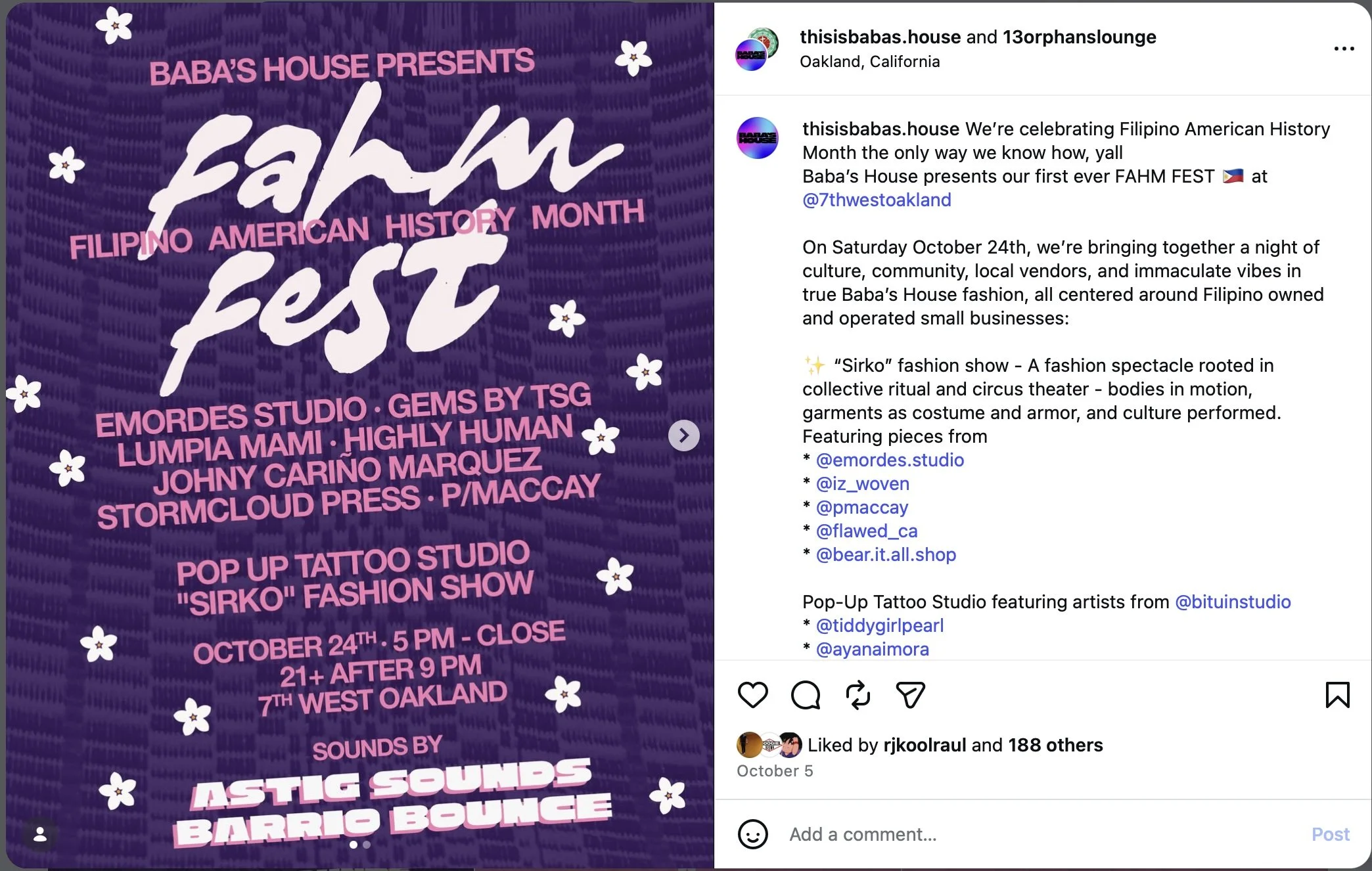
These aren't copies of UNDISCOVERED, and they shouldn't be. Each festival belongs to its creators, its community, and its place. That's precisely what makes the story exciting. The people who participated in one cultural experience gained relationships, confidence, and inspiration to make something entirely their own.
The Ripples Cross a Border
The influence didn't stop in the Bay Area.
Organizers behind the Kultivation Festival in Canada told us directly that UNDISCOVERED helped inspire their own work. They looked at what we had built in San Francisco as they developed their festival and worked toward creating a Mabuhay District in their community.
That is a remarkable thing to hear. We built UNDISCOVERED around a very particular place—SOMA Pilipinas—and a particular Filipino American cultural experience. Yet something about the model resonated with Filipino Canadians imagining what cultural space and cultural ownership could look like where they live.
The takeaway isn't that every city should have its own UNDISCOVERED. It's that communities can learn from one another and then create something that speaks in their own voice.
A City Learns to Think Differently About Night Markets
Another ripple is visible all over San Francisco.
When we launched UNDISCOVERED, night markets weren't yet the familiar neighborhood economic-development strategy they have become. We helped demonstrate that a cultural event could also function as a platform for local entrepreneurs, draw people to a commercial corridor, and change how residents experience public space.
Today, night markets and recurring street activations have spread across the city. Many people and organizations contributed to that growth, and we don't claim to have created every market that followed. But UNDISCOVERED helped show that the concept could work—and that communities could use culture as an economic development tool.
That work came full circle when two UNDISCOVERED co-creators, Dre and Desi, joined the founding team of Downtown First Thursdays, which has grown into one of San Francisco's most prominent recurring downtown street celebrations.
There's something satisfying about that evolution: an experiment rooted in a Filipino cultural district influencing how the larger city thinks about culture, commerce, and public space.
What We Actually Built
Ten years of UNDISCOVERED can be measured in events, audiences, vendor sales, and performances. Those numbers matter, especially because they represent real economic opportunities for small businesses and artists.
But they don't fully capture the legacy.
The more powerful measure might be the people who were inspired to take a risk. The vendors who became organizers. The collaborators who became founders. The communities that saw a model and adapted it for their own neighborhood, city, or country.
In the end, we weren't just building an audience. We were helping build an ecosystem of cultural producers.
And that ecosystem has grown beyond us.
We don't know exactly what the next chapter of UNDISCOVERED will look like. After ten years, it's okay to acknowledge that uncertainty. Reflection doesn't always have to end with a grand announcement about the future.
Sometimes it is enough to look around and recognize what has already happened.
Ten years ago, we threw a rock into a pond. The ripples are still spreading.
And the most beautiful part is that they no longer need us to keep moving.